
Indonesia’s strategic ascent in the global energy landscape has reached a defining juncture as the administration of President Prabowo Subianto solidifies a vision for total mineral sovereignty. At the heart of this ambition is a transition from being a passive exporter of raw materials to becoming an active global hub for battery manufacturing and electric vehicle (EV) innovation. This “downstreaming” mandate—a cornerstone of the national agenda toward Golden Indonesia 2045—is no longer just a policy of industrial value-addition; it is a geopolitical statement of localized resilience and energy sovereignty.
The current vision is anchored in the “Red-and-White Cabinet” agenda, which prioritizes downstream industrialization to drive a projected 8% annual economic growth. By leveraging Indonesia’s status as the world’s largest nickel producer, the government aims to bridge the gap between extraction and high-technology application. The roadmap envisions an integrated ecosystem where domestic nickel laterite ores are processed through High-Pressure Acid Leaching (HPAL) technology to produce battery-grade nickel and cobalt sulfates, eventually feeding into local Gigafactories. As of 2026, the progress is measurable: the Ministry of Industry reports the establishment of over 60 EV manufacturing firms and dozens of charging station providers, signaling that the “Nickel-to-Battery” ecosystem is rapidly moving from theory to industrial reality.
Central to the President’s vision is the concept of a “closed-loop” economy. This involves not only the production of new batteries but also the management of the entire lifecycle, including Battery Energy Storage Systems (BESS) for renewable energy and robust recycling initiatives. The administration has emphasized that for Indonesia to lead, it must also master the standards of safety and sustainability. This is reflected in the mandatory adoption of international standards like UNR 100 and UNR 136 for battery safety, integrated into the National Standardization (SNI) framework. By enforcing these rigorous criteria, Indonesia is building the consumer trust necessary to accelerate domestic EV adoption while ensuring that Indonesian-made batteries are competitive in the stringent European and North American markets.
However, the vision recognizes that technology alone cannot sustain an industry; it requires a workforce equipped for the “Green Jobs” revolution. The government has intensified its focus on human resource certification, targeting the creation of hundreds of thousands of specialized roles in battery maintenance, materials science, and advanced manufacturing. By aligning vocational training with the specific needs of the battery supply chain, Indonesia is addressing the critical skills gap that has historically hampered large-scale industrial shifts. This investment in human capital is projected to yield significant economic returns, reinforcing the idea that downstreaming is as much about social mobility as it is about industrial output.
Furthermore, the President has positioned Indonesia as a key mediator in the global supply chain, inviting international stakeholders to foster strategic partnerships that move beyond simple trade. The push for “Resource Diplomacy” seeks to secure access to complementary minerals like lithium and copper through bilateral agreements, ensuring that Indonesia’s battery ecosystem remains resilient against global market volatility. This proactive stance is designed to mitigate the risks of overcapacity and price fluctuations seen in previous years, positioning the nation as a stable, long-term partner for the global EV transition.
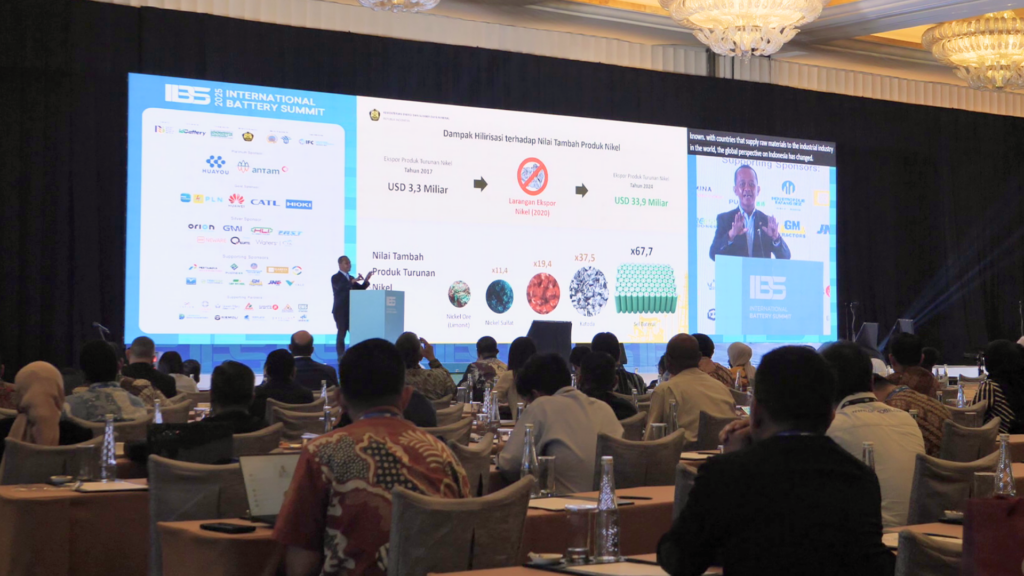
As the International Battery Summit 2026 convenes, the focus remains on the execution of this comprehensive vision. The summit serves as the ultimate platform for industry leaders, policymakers, and innovators to align their strategies with Indonesia’s downstreaming goals. The path toward Golden Indonesia 2045 is paved with nickel, but its success depends on the collective ability to transform those resources into a sustainable, high-tech future. IBS 2026 stands as the catalyst for these crucial dialogues, ensuring that the President’s vision translates into actionable investment and lasting industrial leadership.